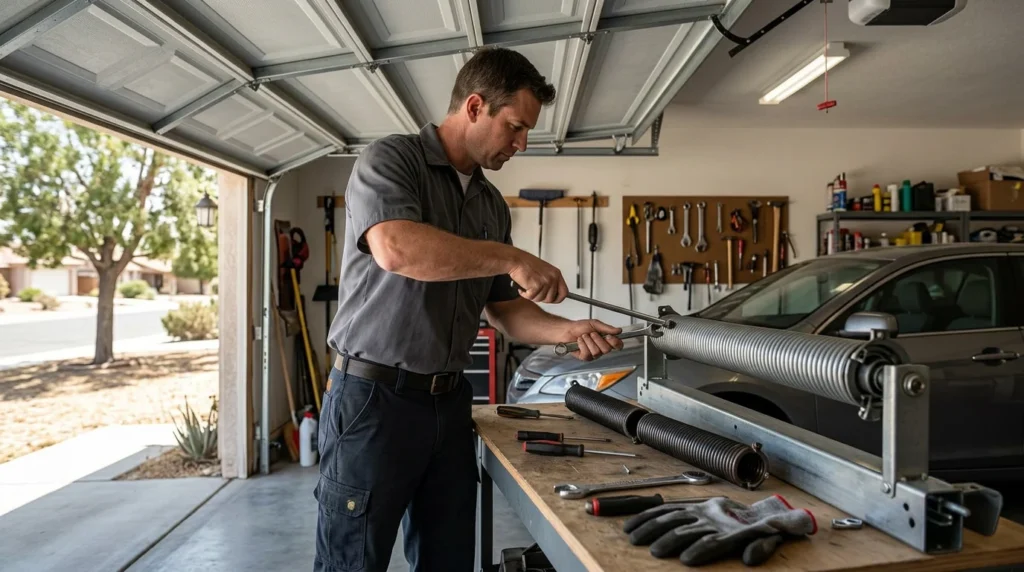
Quick answer: Yes—most homeowners should get professional help for a broken garage door spring. Springs store high torque/tension, and the wrong tools or steps can cause serious injury or property damage. If your door won’t open, feels unusually heavy, or you heard a loud bang from the garage, stop using it and arrange spring replacement plus a door balance and safety check.
Why Broken Springs Are a Stop-Use Problem
A garage door spring isn’t a convenience part; it’s the counterbalance that makes a heavy door manageable. Many residential doors weigh roughly 130–300+ pounds depending on size and construction, and the spring system is what offsets most of that load. When a torsion or extension spring breaks, the opener may strain, the cables can go slack, and the door can drop unexpectedly or get stuck halfway. Industry safety guidance treats spring work as high-risk because of stored mechanical energy; for example, the U.S. Consumer Product Safety Commission (CPSC) has long warned that garage doors and openers can cause serious injuries if components fail or are handled improperly.
Common signs include a sudden loud bang, a door that only lifts a few inches, a door that feels much heavier than normal, or an opener that hums but can’t move the door. With torsion springs (mounted above the door), you may see a visible gap in the coil. If you’re searching for broken spring repair apple valley, plan on keeping the door closed and avoiding DIY tension work while you line up service.
If your car is trapped inside, don’t pull the emergency release and try to “muscle it” alone. Two adults can sometimes lift a door manually, but only if the door is aligned and you can control it the entire time. If anything feels jerky, crooked, or unstable, stop and wait for a technician.
What to Do Now: A Quick Safety Checklist
Use this checklist to reduce risk while you’re waiting for service:
1) Stop using the opener. Repeated attempts can strip gears, bend the top section, or pull cables off the drums when the spring isn’t carrying the load.
2) Keep the door closed if possible. A closed door is generally more stable than a partially open door with compromised counterbalance.
3) Don’t pull the emergency release unless you have a plan. With a broken spring, the door can feel far heavier than expected and may slam down.
4) If the door is stuck open: keep people out of the opening, don’t stand under it, and call for help. If you can do so safely, support the door with locking pliers/clamps on the tracks just below the bottom rollers to reduce the chance of it sliding down, and avoid moving it further.
5) Tell the dispatcher specific symptoms. Mention “possible broken spring,” whether the door is stuck open/closed, any visible cable slack/off-drum condition, and whether a vehicle is trapped. That helps them bring the right springs and hardware.
What a Spring Repair Visit Typically Includes
Spring replacement is more than swapping a coil. A technician will identify the correct spring type and size, then safely unwind or control the remaining tension, replace the spring(s), and set the proper preload so the door balances at mid-travel. Balance is the goal: the door should stay put when opened halfway, not drift up or crash down.
Good spring service also checks related wear points that often show up at the same time: frayed lift cables, worn end bearings, loose center brackets, misaligned drums, and rollers that bind. If a spring broke because the door was binding in the tracks, replacing only the spring can leave you with another failure later.
After replacement, the opener should be reconnected and tested. Many openers have force and travel limits that may need adjustment so the door reverses properly and doesn’t overwork the new springs.
Apple Valley Considerations and Choosing Repair Help
In Apple Valley and the High Desert, big day-to-night temperature swings are common. Metal springs expand and contract with temperature, and while temperature changes alone don’t “cause” a break, they can change how a door feels from morning to afternoon and may reveal a spring that’s already near the end of its cycle life. Windy, dusty conditions can also contribute to track and roller grit, which increases door friction and can make a marginal spring fail sooner.
Ask what spring type you have (torsion vs. extension), whether they recommend replacing both springs if your door uses a pair, and what safety checks they perform after the swap (balance test, cable/drum inspection, opener reversal test). A clear explanation of what failed and why is a good sign you’re getting a real repair, not guesswork.
Next step: Contact a licensed garage door technician for spring replacement and a full safety check.